
Understanding cashew grades is the first step to making informed decisions in the global nut trade. Discover how a simple number can unlock quality, value, and market success. Discover how different cashew grades like W180, W210, W240, and W320 influence export quality, flavor, and market value.
What Are Cashew Grades and Why Do They Matter?
Cashew grades are standardized classifications that sort cashew kernels based on size, color, shape, and quality. This system provides a universal language for buyers and suppliers, ensuring that products meet specific expectations for appearance and performance in various applications.
In the global cashew trade, these grades directly determine price, intended use, and target market. Whether you’re a snack brand seeking the most visually appealing nuts or a food manufacturer looking for cost-effective ingredients, understanding this grading system is crucial for making profitable purchasing decisions.
The Role of Cashew Grading in Global Trade
Cashew grading serves as the backbone of international trade, creating a framework that benefits all parties involved.
- Quality Control: Grading provides the final checkpoint before products reach consumers. It ensures that cashew kernels are fully developed, free from insect damage, and devoid of undesirable spots, guaranteeing a consistent and reliable product.
- Pricing Standardization: The system creates a transparent pricing structure where larger cashew grades command higher prices. A W180 grade, for instance, is significantly more expensive than a W320 grade due to its scarcity and larger size.
- Market Efficiency: Standardized grades streamline communication between international buyers and sellers, reducing misunderstandings and disputes. This efficiency is vital for the smooth operation of a global industry worth billions of dollars annually.
Who Sets the Cashew Grading Standards?
Several organizations maintain and promote the standards that keep the global cashew trade consistent.
- National Organizations: The Cashew Export Promotion Council of India (CEPCI) and the Vietnam Cashew Association (VINACAS) are prominent bodies that establish detailed grading specifications for their respective regions.
- International Bodies: The Association of Food Industries (AFI) in New York has developed Commercial Quality Standards that are widely adopted internationally. The United Nations Economic Commission for Europe (UNECE) also provides classification guidelines that influence global trade.
- Industry Adoption: While these standards provide formal structure, the grading system is universally understood and applied by cashew processors and exporters worldwide, creating a de facto global standard.
Understanding Cashew Grade Codes — W180, W210, W240, W320
Decoding the system is straightforward once you understand the basic nomenclature used across the industry.
What Does the “W” Stand For?
The “W” in cashew grades stands for “White Wholes”. This designation indicates that the kernels are:
- White or pale ivory in color, representing the highest quality in terms of appearance.
- Whole, meaning they have the characteristic shape of a cashew kernel and are not broken (with not more than 1/8th of the kernel broken off).
What Do the Numbers Mean?
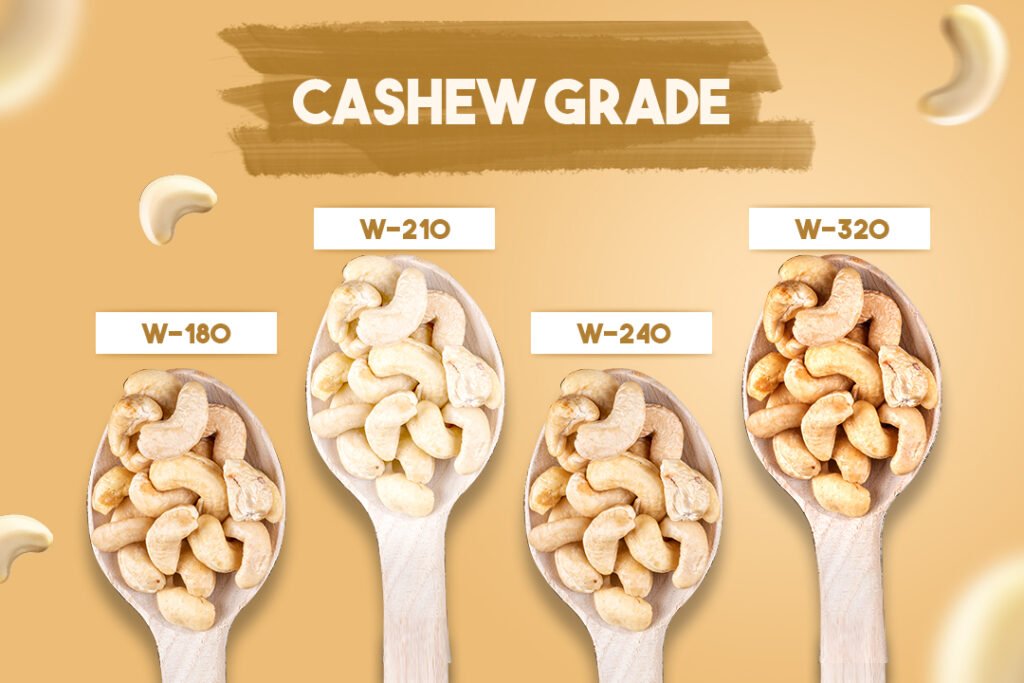
The number in cashew grades (180, 210, 240, 320, etc.) indicates the approximate number of nut kernels per pound (approximately 454 grams).
This creates an inverse relationship between the number and the size: a lower number means fewer nuts per pound, which means larger individual kernels, resulting in a higher grade and price.
Cashew Grade Comparison Chart
The table below summarizes the key characteristics of the most common whole white cashew grades, helping you quickly understand their differences and primary applications.
W180 – The King of Cashews
W180 cashews are the pinnacle of quality and size. Known as the “King of Cashews,” their scarcity and exceptional quality contribute to their high price, making them the epitome of luxury. These nuts are characterized by their large size, plump shape, and uniformity. They are typically reserved for gourmet purposes, luxury snack brands, and high-value gift boxes where visual appeal justifies the premium cost.
W210 – The Jumbo Grade
W210 cashews, often called “Jumbo” cashews, are slightly smaller than W180 but still boast excellent taste and quality. They represent a high-value option for suppliers looking to offer a premium product that is marginally more accessible than the W180 grade. This grade is commonly used in various culinary applications, including baking, cooking, and snacking, offering a delightful crunch and nutty flavor to dishes.
W240 – The Balanced Choice
The W240 grade provides a sweet spot for many businesses. These are large, white kernels that are highly popular for achieving a balance between quality and cost. This grade is a common choice for general snacking, nut mixes, and standard premium retail packs. For buyers seeking a substantial cashew without the premium price of the jumbo grades, W240 represents an optimal balance.
W320 – The Most Popular Export Grade
W320 is the workhorse of the cashew industry, representing the most common and in-demand grade worldwide. Its popularity stems from its wider availability and more accessible price point, while still maintaining a commendable quality and flavor profile. This versatility makes W320 the go-to grade for everyday snacking, confectionery, bulk exports, and a wide range of food service applications.
How Cashew Grades Affect Pricing and Market Demand?
The relationship between cashew grades, their market value, and their demand is driven by a combination of factors including scarcity, production costs, and regional preferences.
Size vs. Price Relationship
The fundamental rule in cashew pricing is that larger grades command higher prices. This price structure exists because:
- Lower Yield: Larger cashew nuts are naturally less abundant, making grades like W180 and W210 more scarce.
- Higher Processing Costs: Larger kernels require more meticulous sorting and handling during processing, which increases production costs.
- Visual Appeal: The impressive size and uniformity of larger grades like W180 have greater visual appeal for consumers, particularly in gift and premium snack segments, creating higher perceived value.
Market Preference by Region
Different markets around the world have developed distinct preferences for cashew grades based on consumption patterns and cultural factors.
- Western Markets: North America and European markets often show strong demand for the W240 to W320 range for everyday snacking, valuing the balance between size and affordability.
- Luxury & Gift Markets: For high-end products, gourmet stores, and gift boxes, Western brands may specifically seek out W180 and W210 grades for their superior presentation.
- Asian Markets: India, as both a major producer and the world’s largest consumer of cashews, has a robust domestic market for various grades. Vietnam also imports large quantities for processing and re-export.
Packaging and Export Considerations
The choice of cashew grade significantly influences logistics and marketing strategies.
- Export Packaging: Premium whole grades are often packed using methods like the Vita pack method, which involves exhausting air from the tin and pumping in carbon dioxide to preserve freshness and prevent spoilage during transit.
- Shelf Display: Larger, whole grades are typically showcased in transparent packaging to highlight their size and uniformity, which are key selling points.
- Supply Chain Stability: Consistently available grades like W320 ensure reliable procurement for manufacturers, making it easier to maintain steady production lines and inventory.
Choosing the Right Cashew Grade for Your Business
Selecting the appropriate cashew grade is a strategic decision that impacts your product quality, cost structure, and market competitiveness.
For Retail / Consumer Packaging
- Premium/Gift Packaging: Opt for W180 or W210 grades. Their large size and uniform appearance justify a higher price point and create an impression of luxury and quality, ideal for holiday gifts or specialty health food stores.
- Standard Retail Packs: W240 and W320 grades are excellent choices for everyday consumer packs. They offer great quality at a more accessible price, appealing to a broader customer base for routine snacking.
For Wholesale / Bulk Exports
- Bulk Shipments: The W320 grade is the most popular choice for bulk exports due to its widespread availability and competitive pricing. It meets the needs of a wide range of customers and applications.
- Cost-Sensitive Bulk: For businesses where price is the primary driver, such as large-volume ingredient sales, W450 or even higher count grades provide a budget-friendly option without sacrificing the benefits of whole kernels.
For Food Processing / Bakery / Confectionery Use
- Granola, Cereal & Protein Bars: Large Pieces (LWP) and Splits (S) are ideal as they provide substantial cashew flavor and texture without the cost of whole nuts.
- Nut Butters, Spreads & Sauces: Small White Pieces (SWP) and Baby Bits (BB) are perfectly suited for these applications where visual appeal is not a factor, but flavor is paramount.
- Baking and Confectionery: Scorched Wholes (SW) or Dessert Wholes (DW), which may have slight discoloration but retain good flavor and nutritional value, offer an economical solution for products where the nuts will be incorporated or coated.
Final Thoughts — Quality, Flavor, and Trust in Every Kernel
In the intricate world of global cashew trade, understanding grades is more than a technicality—it’s a fundamental business skill. The grading system brings order, transparency, and predictability to a complex commodity market. From the luxurious W180 to the versatile W320 and the cost-effective broken pieces, each grade has its place and purpose, serving diverse markets and applications.
Ultimately, consistent quality grading builds trust with global buyers. When a shipment labeled W320 reliably contains the expected size and quality, it fosters long-term partnerships and maintains brand reputation. This trust, built kernel by kernel, is the true foundation of a successful export business. By mastering cashew grades, you empower yourself to make informed decisions, optimize costs, and deliver exactly what your customers expect, strengthening your position in the dynamic global nut trade.